
Community Leaders & Books: June 2026
We profile local community leaders and post book reviews on a weekly basis on social media, along with excerpts from Nature Companion, our nature app/website. Once a month we repost these items on our website for those of you who may not be active on social media.
Community Leaders
Alberta: An Eco-Solar Home tour on June 20 and 21 was an opportunity to review rammed earth, passive house, solar arrays, wind turbine, water collection, and other projects. Photos of the tour are available online. [Eco-Solar Home Tour Society of Alberta]
Manitoba: CPAWS Manitoba’s Nature Club offers free outdoor activities on a regular basis. The August events include a how-to-camp workshop, a group hike, connecting to nature through theatre, and junk journaling. [CPAWS MB]
Saskatchewan: Wanuskewin hosted an interactive one-day workshop on June 27 featuring a prescribed fire demonstration and tour of ongoing restoration efforts at the Northeast Swale (Wildflowers of the Northeast & Small Swale brochure - PDF) [Wanuskewin, Canadian Prairies Prescribed Fire Exchange]
British Columbia: A BC Nature Club webinar introducing MycoMap BC, a fungal biodiversity dataset designed to better understand BC’s mushrooms, assist taxonomists, and support fungal conservation by tracking how fungi respond to environmental change, is now available on YouTube. [BC Nature]
Books
My Life with Wolves: How I Became the Storyteller for the Yellowstone Packs by Rick McIntyre: “Although many people call me a wildlife biologist, I think of myself primarily as a storyteller. I am well aware that wolves are controversial and that many people dislike them. That is why I tell wolf stories in my books and talks and why I am optimistic about changing people’s attitudes toward wolves. I have had the privilege of witnessing the stories of the wolves and it is my responsibility to tell those stories to as many people as possible.”
How Flowers Made Our World: The Story of Nature’s Revolutionaries by David George Haskell: “When flowers evolved, they upended and transformed the planet. They were late arrivals on the world stage, appearing about two hundred million years ago, long after the evolution of complex animals and other land plants. By one hundred million years ago they were the foundation of most habitats on land. Earth was forever changed by flowers. They created habitats like tropical rainforests and prairies, and catalyzed the evolution and diversification of bees, butterflies, birds, mammals, and many other animals. Today, 90 percent of all plant species on the planet are flowering plants. They provide food and habitat for much of life on Earth. Without them, humans would not have evolved, nor could we feed ourselves today. Flowering plants are some of life’s great revolutionaries. They belong at the center of the story of how our world came to be.”
Clearing the Air: A Hopeful Guide to Solving Climate Change in 50 Questions and Answers by Hannah Ritchie: “We are not only capable of solving climate change but also poised to create a better future for ourselves in the process. To do that, we first need to understand that it’s possible, then get serious about building the future we want – a future that the media and public discourse would have you believe is impossible.”
The Tree Book: The Stories, Science, and History of Trees published by Smithsonian: “Combining science with history, and folklore with culture, The Tree Book is an immersive guide to the world’s best-loved and most extraordinary species. Its warmly illustrated pages – full of sacred banyans, long-lived baobabs, towering sequoias, and gnarled oaks – reveal trees’ inner workings and show how they support the other inhabitants of our planet, from fungi to humans.”
Nature Companion
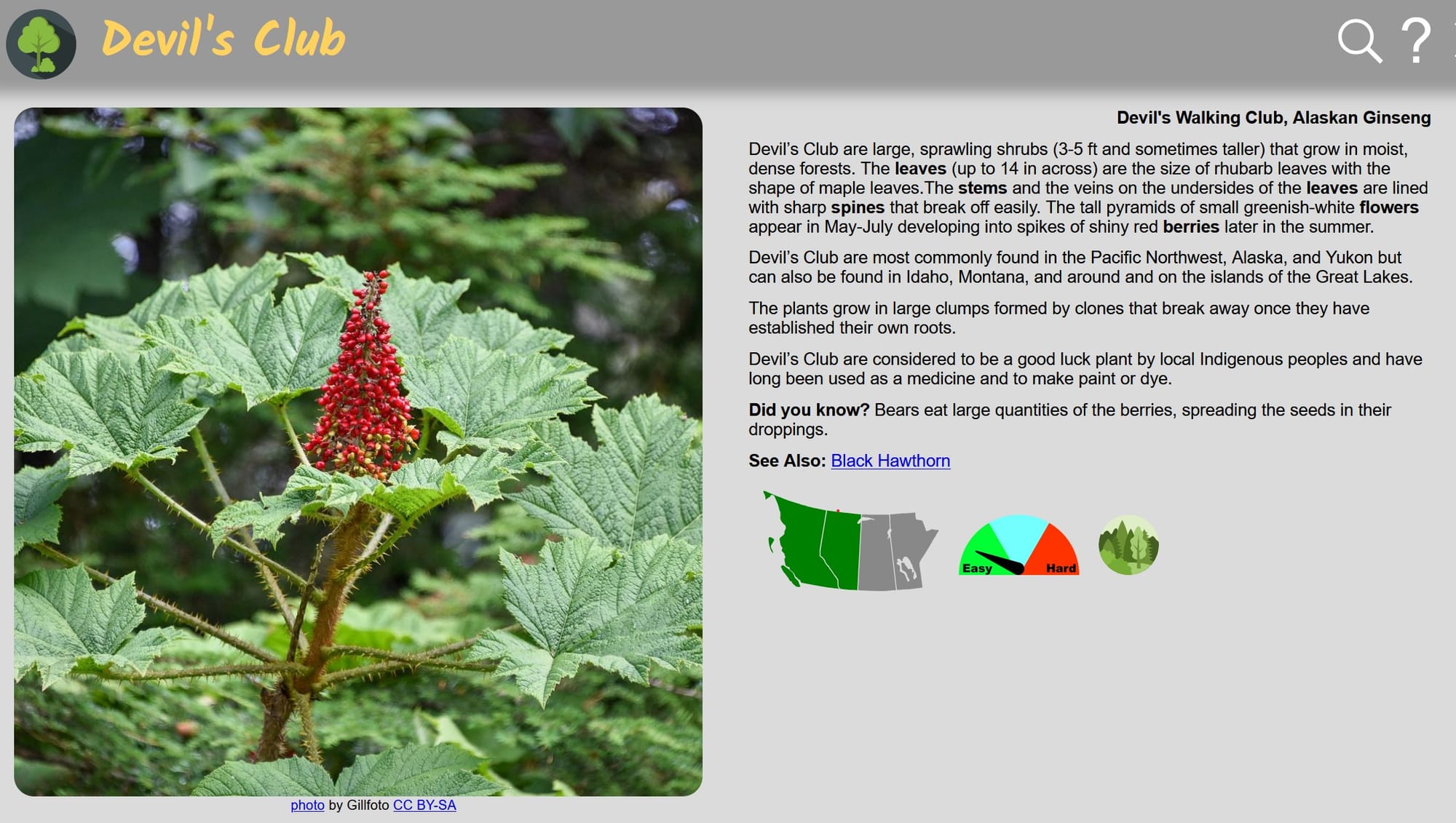
Bears eat large quantities of Devil’s Club’s shiny red berries, spreading the seeds in their droppings. (Nature Companion is a free app/website introducing many of the plants and animals found in Canada’s four western provinces.)
Photo credit: https://www.flickr.com/photos/apmckinlay/55301602958/
EcoFriendly West informs and encourages initiatives that support Western Canada’s natural environment through its online publication and the Nature Companion website/app. Like us on Facebook, follow us on BlueSky, X, and Mastodon, or subscribe by email.
Member discussion