Community Leaders & Books: July 2026
We profile local community leaders and post book reviews on a weekly basis on social media, along with excerpts from Nature Companion, our nature app/website. Once a month we repost these items on our website for those of you who may not be active on social media.
Community Leaders
Alberta: A family-friendly hike to Window Mountain Lake on July 19 was an opportunity for participants to learn about Alberta’s iconic but endangered whitebark pines and to assist with tree health surveys. Participants also learned about the toxins that lie beneath the surface of one of southwest Alberta’s most popular mountain lakes and how they impact the province’s watersheds. [Alberta Wilderness Association]
Manitoba: Trees Winnipeg is hosting a series of tree walks this summer around some of the city’s parks and neighbourhoods. An arborist and a local historian share information about the history of the spaces, the types of trees planted there, and signs of good and bad tree health. [Trees Winnipeg]
British Columbia: If you’re visiting Tofino on Vancouver Island, be sure to take in some of the free outdoor activities offered by the Raincoast Education Society – plankton exploration, rainforest walks, and beach seines. [Raincoast Education Society]
Saskatchewan: The Kelsey Ecological Society went on a short driving tour on August 15 to discover the stories preserved in local historical cemeteries and the surprising diversity of life they continue to support. [Kelsey Ecological Society]
Books
Eyes in the Soles of my Feet: From Horseshoe Crabs to Sycamores, Exploring Hidden Connections to the Natural World by Caroline Sutton: “The idea of considering the many ways to see and otherwise sense the world ignited my curiosity as to how nonhuman species go about their lives using their sensory powers … I’ve found it stunning to consider that I will never experience what many species are capable of – to see UV as it streaks across a bay, or to sense the earth’s magnetic poles with confounding precision – and yet I’m enriched by knowing these faculties exist. Recognizing our own limitations can lead us to question our assumptions. It can inspire empathy and respect for the plants and animals that share the air we breathe, whose survival is intertwined with ours.”
Wild Orcas: A Deep Dive into the World of Killer Whales by Hanne Strager and Catherine DeNardo: “This book explores all things killer whale – their remarkable hunting skills, their ability to coordinate and strategize, their unique dialects, and their rituals and traditions. It explores how killer whales communicate, how they teach their customs to the next generation, and the difference between innate behavior and learned behavior. It showcases the connections between them and us: they live in family groups, the females go through menopause, they grieve.”
In Wild Cities: Discovering New Ways of Living in the Modern Urban Jungle, Chris Fitch sets out on a globe-spanning journey to see if he can find “a city that balances the social and cultural lifestyle that makes cities great, with the ecological biophilic conditions that humans crave. He asks, “Does such a place exist? If I can’t find one perfect city, maybe inspiring stories from many different cities would be just as good, or even better?” From the tiny urban forests in Tokyo and the star-rich skies of Flagstaff, to the meandering river channels of Munich and free-prowling lions of Nairobi, this is a globe-spanning look at how to bring nature into the places we live – and how to create the wild cities of the future.
A Year with the Seals: Unlocking the Secrets of the Sea’s Most Charismatic and Controversial Creatures by Alix Morris: “We believe we understand seals because we share, at times, this small sliver of coastline where our physical worlds collide. For brief moments, we observe them, as they observe us. We laugh at their clumsy awkward movements, their banana-shaped poses as they dry their heads and hind flippers in the salty air. We have a small window into their land lives, but their underwater lives remain a virtual mystery. Beneath the surface, seals transform from giant russet potatoes sunbathing on a rock into sleek torpedoes – their flippers propelling them through the water at tremendous speeds, their movements graceful, agile.”
Earth & Life: A Four Billion Year Conversation by Andrew H. Knoll: “Earth’s transformation through time owes much to physical processes, none more important than plate tectonics. These processes, originating in the mantle, have given rise to stable continents, with their mountains and plains, as well as majestic arrays of volcanoes, many emerging from the sea. Life, in turn, has made possible the environmental transitions that converted an anoxic planet into one whose oxygen-rich surface can support complex multicellular organisms. Importantly, the world in which we live is not simply a function of physical Earth history; nor has it been shaped exclusively by organisms. Our Earth – our home – reflects interactions between physical and biological processes that have played out over billions of years: the conversation between Earth and life.”
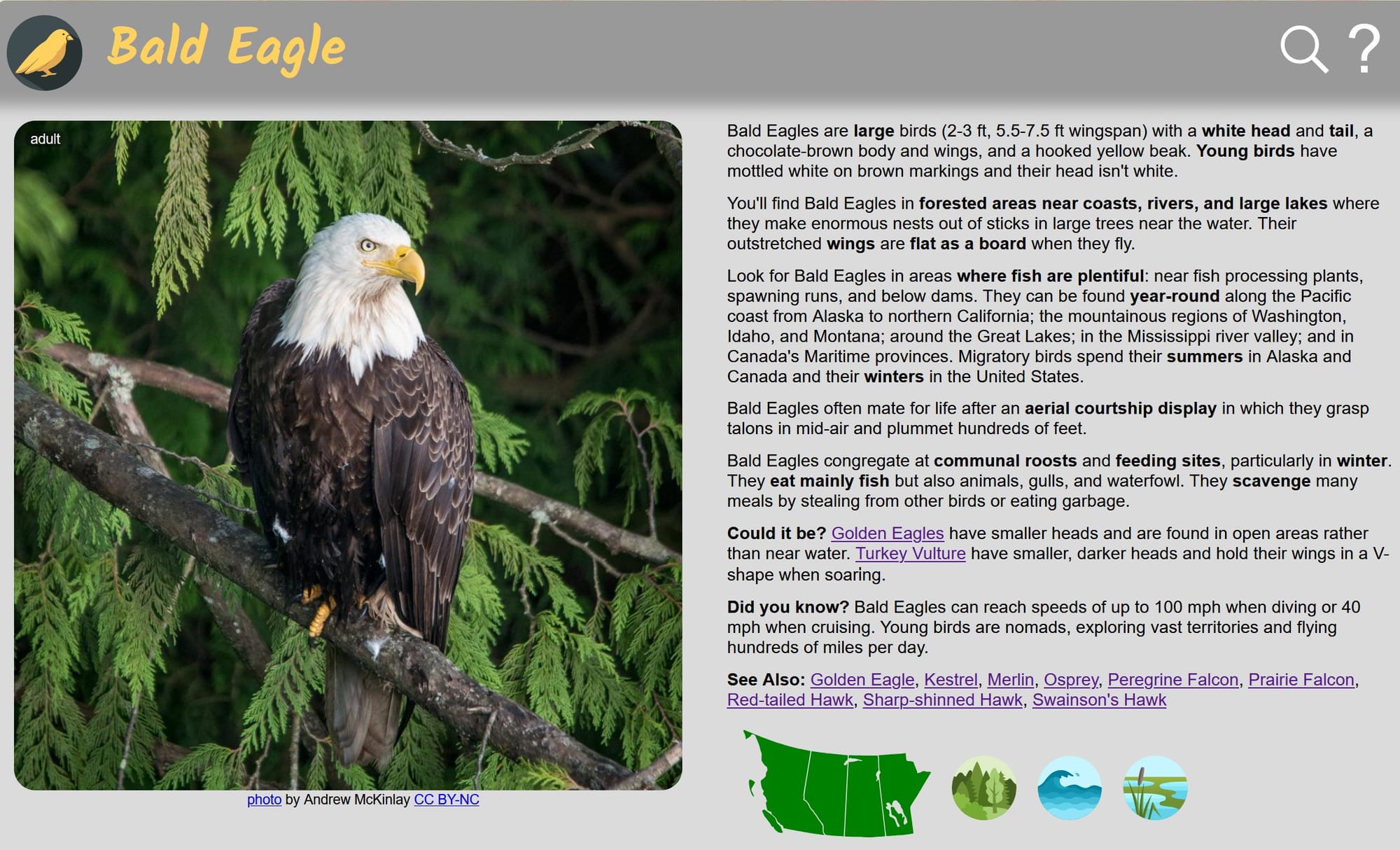
Nature Companion
Young Bald Eagles are nomads, exploring vast territories and flying hundreds of miles per day. (Nature Companion is a free app/website introducing many of the plants and animals found in Canada’s four western provinces.)
Photo credit: https://www.flickr.com/photos/apmckinlay/25216011426
EcoFriendly West informs and encourages initiatives that support Western Canada’s natural environment through its online publication and the Nature Companion website/app. Like us on Facebook, follow us on BlueSky, X, and Mastodon, or subscribe by email.
Member discussion