
Community Leaders & Books: August 2026

We profile local community leaders and post book reviews on a weekly basis on social media, along with excerpts from Nature Companion, our nature app/website. Once a month we repost these items on our website for those of you who may not be active on social media.
Community Leaders
Saskatchewan: The Qu’Appelle Valley Environmental Association hosted a day-long seminar on September 12 on Protecting Prairie Water, Habitat and Health. A keynote address by Dr. Peter Leavitt, University of Regina, was followed by a panel discussion entitled Finding Common Ground – Treaty Rights, Drainage, Land Ownership, Climate and Health. [Qu’Appelle Valley Environmental Association]
Alberta: The Medicine Hat Interpretive Program, managed by the Society of Grassland Naturalists, offers a variety of educational programs for children and adults in Police Point Park. On August 12, kids ages 4-10 were invited to use microscopes to investigate teeny, tiny things. [Medicine Hat Interpretive Program]
Manitoba: BeeBetter Manitoba’s new website provides information about pollinators and why they’re important, ways to take action in your communities, a Public Garden Program, a Grower and Retailer Program, as well as resources to help you choose the right plants and provide garden care that supports pollinators year-round. [BeeBetter Manitoba]
British Columbia: Emma Menchions, IMERSS, and the Swan Lake Nature Sanctuary hosted an interactive seminar on August 22 for residents interested in joining a community search for rarely spotted plant species on Saanich Peninsula, Vancouver Island. [Swan Lake Nature Sanctuary]
Books
In How to Fall in Love with the Future: A Time Traveller’s Guide to Changing the World, Rob Hopkins, co-founder of the international Transition Network movement, invites us to travel to future worlds we would actually want to live in. He says, “Mental time travel matters. It allows us to believe that other futures exist, that they’re possible, that they’re there in front of us, and that we can start living as though they’re already here. We can rehearse different futures. It makes the necessary changes easier because we can see beyond the undesirable effort and into the desirable outcome.”
In Trees: An Exploration, Robert Moor: “Over the course of my research, I eventually came to understand that there are many reasons why trees inspire such powerful feelings of reverence in us. Trees outlive us, expanding our sense of time; they tower over us, putting our lives into perspective; they provide for us, inspiring a sense of gratitude; and they trouble us, challenging us to embrace what John Fowles calls the ‘green chaos’ of the more-than-human world.”
A Bird’s IQ: Innovation, Intelligence, and Problem Solving in the Avian World, Louis Lefebvre: “Blending his decades of scientific research with engaging anecdotes, Lefebvre examines the evolutionary forces that have shaped avian intelligence. He explores how birds adapt to urban environments, innovate in response to challenges, and pass down knowledge across generations. This goldmine of bird behavior yields an ‘innovation quotient’ (like our human IQ) widely used by researchers to measure and rank how innovative a bird species is.”
The Radiant Sea: Color and Light in the Underwater World, Steven Haddock & Sonke Johnsen: “Imagine you are a fish, darting about a coral reef. Is that distant shadow something to eat, or is it going to eat you? Where can you hide? How can a lonesome fish find a friend around here? The underwater optical environment has several distinct properties very different from what we experience on land … we will explore five ways that organisms interact with light: transparency, pigmentation, iridescence, bioluminescence, and fluorescence. Each of these provides stunning tricks and tools that would help your fish self live to see another day.”
Nature Companion
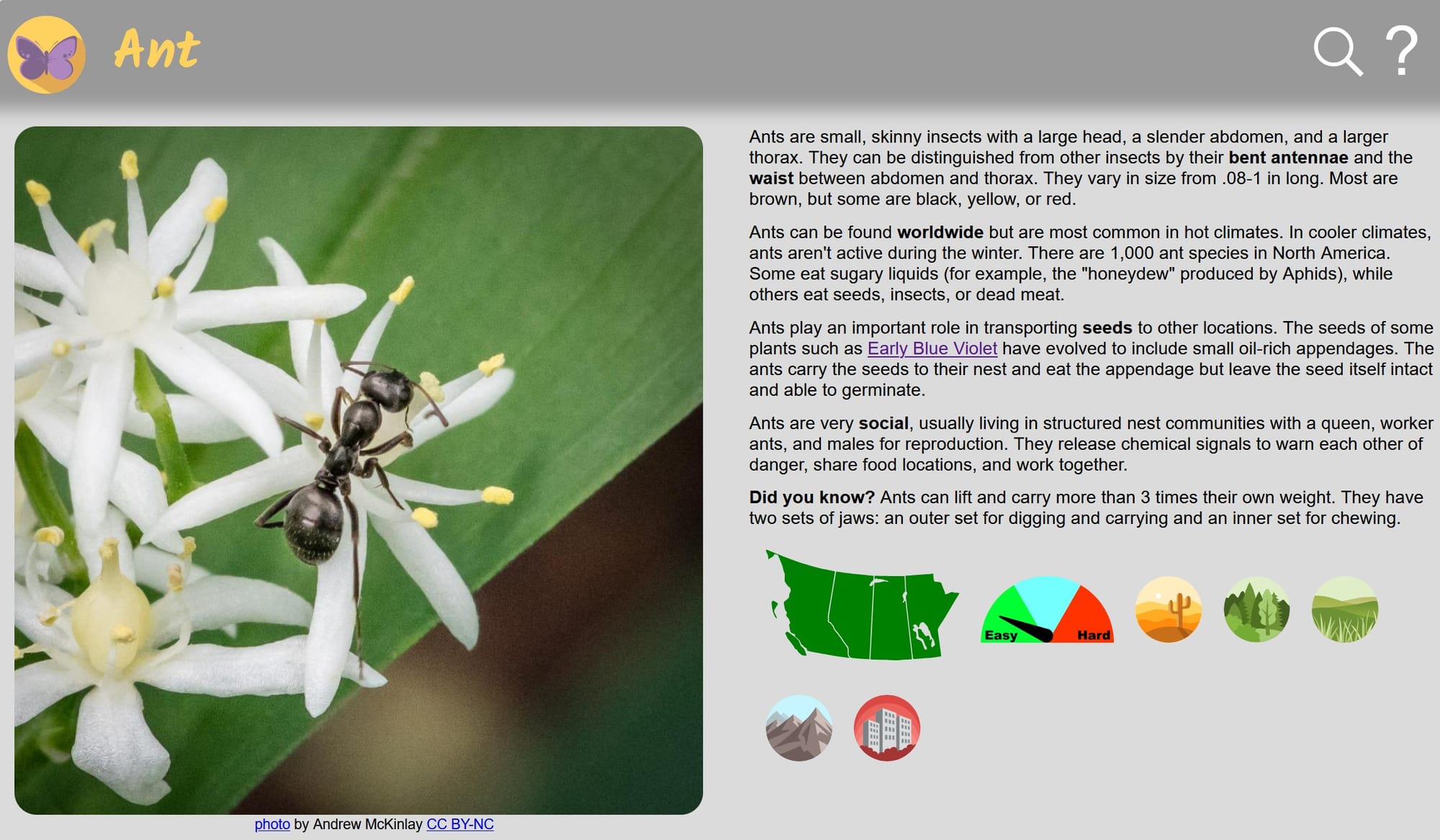
Ants are very social. They release chemical signals to warn each other of danger, share food locations, and work together. (Nature Companion is a free app/website introducing many of the plants and animals found in Canada’s four western provinces.)
Photo credit: https://www.flickr.com/photos/apmckinlay/22186754248
EcoFriendly West informs and encourages initiatives that support Western Canada’s natural environment through its online publication and the Nature Companion website/app. Like us on Facebook, follow us on BlueSky, X, and Mastodon, or subscribe by email.
Member discussion