Community Leaders & Books: October 2026
We profile local community leaders and post book reviews on a weekly basis on social media, along with excerpts from Nature Companion, our nature app/website. Once a month we repost these items on our website for those of you who may not be active on social media.
Community Leaders
Manitoba: The Manitoba Eco-Network, in conjunction with the University of Winnipeg and the Environmental Law Centre, is hosting a series of regional workshops as part of the Critical Reforms: Mining in Manitoba project. The project examines how Manitoba can modernize the provincial laws that govern mining and critical minerals to support a more environmentally responsible and socially-just future for the province. Upcoming workshops are in Winnipeg on November 20 and Brandon on December 3. [Manitoba Eco-Network]
British Columbia: Green Roof Infrastructure Network of BC (GRIN BC) is an interdisciplinary network of green roof champions. They deliver education on green roofs to a variety of audiences, from children to professionals. On November 7, they offered an introductory workshop on designing, installing, and maintaining a small green roof (garage, garden shed). [GRIN BC]
Alberta: Edmonton-based nature photographer Dara Ojo is launching his new book, Tiny Titans: The Silent Keepers of Our Ecosystem, at the Stanley A. Milner Library in Edmonton on November 25. [Nature Alberta]
Saskatchewan: Saskatchewan held Snowflakes & Sticks, its first-ever winter outdoor play conference for teachers and outdoor enthusiasts, near Saskatoon on November 6-7. [Sask Outdoors]
Books
Plant Teachings from My Auntie: Gathering Coast Salish Plants for Medicine, Textiles, Nourishment, and Ceremony, Geraldine Manson & Nancy J. Turner: “Hours of sitting and walking alongside my dear Auntie Ellen began in the early 1990s, with her showing me the trees and other plants, sharing the vital importance of the plant world within the mountains and forests, along the riverbanks, and in the ocean. Her passion for the plant world came with profound respect. Embraced in her teachings is to always honour the plants as we harvest and prepare them because each one holds connection to the land and elements of healing.”
The Fullness of Time: Marking the Day by Birdsong, Blooms, Shadows, and Stars, Cathy Haynes: “This book is an adventure in discovering how past generations told the time of day by signs from the living world or used their own bodies and voices to judge spans of time. In our increasingly clock-bound and screen-immersed existence, it’s an invitation to notice subtle changes in the living world, even in the concrete-and-glass heart of the twenty-first city. Over the coming chapters we will sense time through the day from the dawn chorus, flowers folding up at noon, singers beating the rhythm of a task, the slow slide of shadows and sunbeams, the air turning golden, our planet spinning against the stars. While our world may still tick most loudly to the beat of the clock, by becoming more attentive to signs like these, I hope we might deepen our awareness of the fullness of time.”
Why Animals Talk: The New Science of Animal Communication, Arik Kershenbaum: “It would be a mistake to think that all animals have the same communication needs, and therefore the same communication abilities. Animals such as snails and worms may not have very much that they say to each other, simply because their lives do not require much communication to get on. In contrast, species such as dolphins and chimpanzees possess impressive abilities to communicate with each other, and even with humans. That’s a phenomenon that can only be explained in the context of the interactions between the animals and their environments, and particularly between the animals and other members of their species. Why animals need to talk is the important question to ask before we can answer how and what animals are saying.”
Hidden Creatures: Luscious Leeches, Bashful Botflies and the Wondrous, History-Shaping World of Parasites, Dino Martins: “Still puzzling over the tinier wasps that I’ve found, it dawns on me – these, too, are parasites, but not of the caterpillar directly. They are parasites of parasites. Hyperparasitoids. Wasps eating wasps within a caterpillar! After this discovery, everything changes. I learn that one needs to look beneath the surface. One must see beyond what is obvious. That the world contains many, many layers of mystery and puzzles. That things are not always what they seem.”
The Return of the Oystercatcher: Saving Birds to Save the Planet, Scott Weidensaul: “This is a book about optimism … All around the world – from a tiny island on the coast of Maine to the middle of the Pacific Ocean, from a hereditary estate in England to the deep Carpathian Mountains in Romania, from the middle of the Canadian boreal forest to a watery wilderness where you can hear the air raid sirens in Ukraine screaming at night – people are mapping avenues to recovery if we choose to follow them, making progress for birds. Which means they are making progress for us, too, because a world that works for birds, in all their complexity of movement and ecological need, will work for everything else, including people.”
Nature Companion
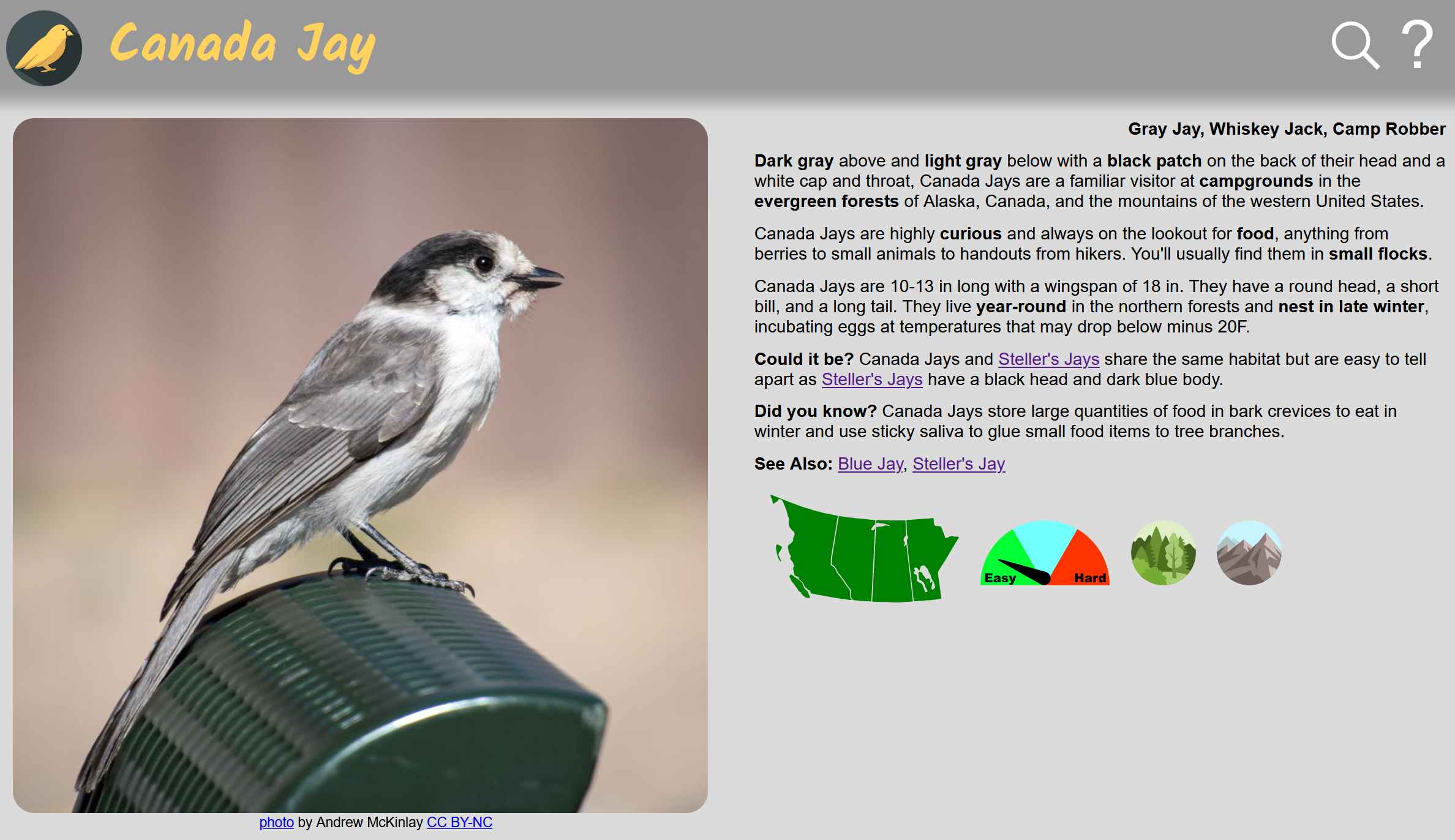
Canada Jays store large quantities of food in bark crevices to eat in winter and use sticky saliva to glue small food items to tree branches. (Nature Companion is a free app/website introducing many of the plants and animals found in Canada’s four western provinces.)
Photo credit: https://www.flickr.com/photos/apmckinlay/48926119317
EcoFriendly West informs and encourages initiatives that support Western Canada’s natural environment through its online publication and the Nature Companion website/app. Like us on Facebook, follow us on BlueSky, X, and Mastodon, or subscribe by email.
Member discussion